Monday, 14 June 2010

Red Hair


N.B. The purpose of this article isn't to objectify red hair or red-headed women. Rather, it explores my own interest in red hair and its cultural presentation. I reassure you that I think all hair colours are beautiful in their own way. :)

Having been told by my hairdresser that it is not possible to dye my dark brown hair red, on the basis that it is very thick and would need bleaching first, I have become even more obsessed with the colour because of its unattainability! Sadly I shall always have to admire red hair from afar.

Here's the closest I'm going to get... and I look like Offred from The Handmaid's Tale with lipstick:

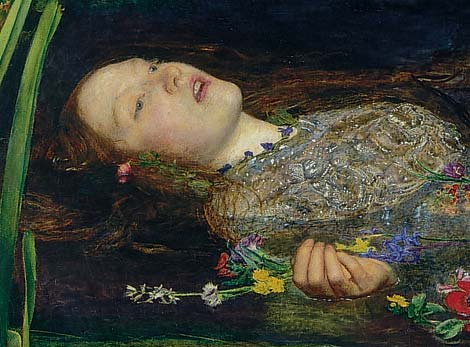
Red hair has always generated fascination, and unfortunately ridicule, which means that I am not alone in my interest. Pre-Raphaelite paintings are a great place to start when investigating the timeless appeal of the hair colour. (N.B. I know very little about art history). In Victorian England, red hair still carried much of the old medieval stigma and was not generally thought of as beautiful. Elizabeth Siddal, a young woman born in 1829 into a humble background, became a mould-breaking model and muse for the painters after she was spotted in her early twenties by artist Walter Deverell. Lizzie, as she was known, looked more like a modern-day runway model than the small, curvaceous Victorian ideal. Her striking face and luminous red hair are timelessly captured in many a pre-Raphaelite painting, most famously John Everett Millais' Ophelia. With tragic irony, Siddal's own life ended in suicide; her poor health and depression culminated in her overdose one year after the birth of her stillborn child. Despite her unhappy life, Siddal made an incredible impact on art and she is immortalised in many iconic paintings.

Culture in the 20th Century was not devoid of red-heads. One of my favourite childhood novels was the 1908 Anne of Green Gables. I identified with the protagonist, but of course I have never had a head of hair that could be ridiculed with the word "carrot." Interestingly, Anne was preoccupied with melodrama and Tennyson's The Lady of Shallot, providing a link with the pre-Raphaelites. Red-haired women graced our screens and celebrity magazines, from Judy Garland's Dorothy in The Wizard of Oz (1939), to wartime starlet Greer Garson, to Paul McCartney's actress girlfriend Jane Asher in the 1960s. In the late 20th century, screen sirens such as Kate Winslet and Nicole Kidman gave red hair a new, "sexy" lease of life. Of course, everyone from my generation understands the significance of the Weasley family in the Harry Potter series.

Recently, red hair has become very fashionable. I saw a promotion in a magazine recently for an auburn hair-dye, with a worrying tagline about keeping up with the new trend. Never one to like following the crowd, I find this mildly irritating. I believe that people should wear what they like, not what they are told to wear, and that the same goes for hair colour. For goodness sake, how can a hair colour be in fashion? It's totally ridiculous, although I hope this triumph of fiery hair and pale skin means that people recognise they live in the United Kingdom and not Ibiza, and thus there will be a reduction in the amount of fake tans. Hmm. Perhaps not. Anyway, I digress. The lining to this silver cloud of fashion is that there are more auburn locks around, and hopefully there will be a reduction in prejudice against red-headed people; please ban the word "ginger."

I shall leave you with some examples of modern-day red-headed people!

Saturday, 12 June 2010

Exactly How I Make My Cupcakes

Many of my friends have asked me what I put in my earl grey cakes to make them so tasty. Well, fortunately it requires no talent or skill, and it's not really anything to do with me, but with the equipment and ingredients I use that make the cakes come out well.

This post is for the purposes of clarifying the little things that turn the cakes from being good to very delicious.

Step One: (Pre-heat oven to 160/180) Heat the milk until it starts to boil, then infuse 4 earl grey teabags in a cup with cling-film or foil over the top for 30 mins.

With this step, I make sure I heat the milk on the stove: do not microwave it! Make sure you use good quality earl grey because it tends to be stronger, meaning your cakes will have more flavour. In fact, my best earl grey cakes are made with leaf tea: I put four teaspoons of strong leaf earl grey into the milk, and then after thirty minutes I use a sieve to get rid of the tea leaves. Teabags work fine though, as long as you don't get impatient (you must leave it for thirty minutes), and give them a good squeeze at the end. The darker and more fragrant your infusion, the better your cakes will be.

Step Two: Put 110g of butter (room temperature) and 225g sugar (granulated) into a mixing bowl and beat for three to five minutes until pale and smooth.

It is absolutely essential that the ingredients are at room temperature. I find the best way of preparing this is to get out your ingredients when you heat your milk, which means they have thirty minutes to get to room temp. Your butter must be really soft, the softer the better without it being melted. When you mix the butter and sugar, use an electric hand-whisk, so you have control over the mixture and ensure it gets a thorough mixing. You must keep going until the mixture is pale and smooth. Remember, the more you mix the cake mixture, the lighter the cakes will be.

Step Three: Add two eggs, one at a time, mixing between. Add 1/2 teaspoon almond extract (optional).

Add one egg, mix, add another egg, mix. Keep mixing, mixing, mixing. Choosing to put the almond extract in is risky: it is incredibly strong and even 1/2 teaspoon, tiny as it sounds, will transform the taste of your cakes. If you slip over that amount, you will mask the taste of the earl grey. Personally, I've used almond extract in my cakes once and I prefer it without; recently I've taken to adding a splash of vanilla essence which works marvellously. If you love almond it does taste good in earl grey cakes, but remember that it is the bergamot flavour that gives these cakes their deliciousness. So don't overdo it!

Step Four: Add 1/3 of the flour, and 1/3 of the earl grey-milk and beat. Repeat until all used up.

I follow this instruction religiously, because I genuinely believe it makes your cakes lighter and tastier than doing it all at once. Get a third of your flour, sieve it (you MUST sieve it) into the mixture, and then pour in a third of your milk. Grab a wooden spoon and stir all the flour in, because if you whisk it immediately the flour will fly up in your face. Once it's stirred in, mix it with your hand-whisk. Then put the next third of flour and earl grey mix, stir with a spoon, mix with your hand-whisk. The final time you do it, make sure you spend ages mixing at the end.

Step Five: Divide mixture into twelve muffin-sized cases and bake!

This doesn't really need any explanation!

ICING

I have taken to completely making this up. I whack a blob of softened butter into a mixing bowl, whisk it, and keep adding icing sugar to it until it becomes really thick and naturally falls into peaks. I usually do lilac icing as it complements the daintiness of the earl grey flavour; I mix a little blue and red food colouring to achieve this. Then I use a butter knife to spread the icing onto the cakes (when they are completely cooled), making sure that it falls into a natural swirl. I top it off with little silver balls or icing flowers.

Hope this is helpful!

J xxx

p.s. Disclaimer: Recipe adapted from the original recipe from Cupcakes from the Primrose Bakery.

Wednesday, 9 June 2010

Guys Suffer Too

One of the misconceptions about feminism that really pisses me off is the commonly heard "Feminists are man-haters and they want to prove that women are superior to men." Feminists who hold that view are increasingly rare, and are usually stuck in some eccentric 70s time-warp and need to get out more. Modern feminism is about empowering women and making sure that we get the education ,confidence and positivity we need to be able to make real choices in the modern world. It's not backward-looking, it's not anything scary (although it can, and does, kick ass), and it certainly does not exclude men.

Men are a central part of my personal feminist philosophy. When reading or writing about feminism, they're always in my thoughts. And I don't mean thinking about them as chauvinists or bigots, and I don't mean thinking about them in terms of my desires-- I'm far too gay for that! The reason I think about guys a lot is because I see the terrible effects tha the all-too-often failings of feminism itself, and the wider fucked-up-ness of our society's attitude to women, have had on our young men.

Guys are confused. And it's no wonder. My favourite pet-hate, that I go on and on about on this blog, is one that particularly screws up the guys as well as the girls. I speak, of course, of the Sexy/Pure Double-Standard. This is one that's particularly close to Jessica Valenti's heart and which she has written about at some length. Girls are expected to be sexy and attractive, expected to have beautiful bodies, expected to get guys. At the same time, girls are expected to be pure, virginal, chaste and innocent. My friend and I were having a conversation today, and she was telling me about how she had observed an attack on a female Facebook friend's status by a bunch of teenage boys, who were calling her "slag," "whore" and other equally charming terms of address. We observed that it's ridiculous how guys complain if they are unable to pull, but if a girl is "up for it," she is immediately no more than her willingness to fuck. For me, part of feminism is about promoting sex positive women, and sex positive young men, and a general understanding that sex is a significant part of our lives but it does not define our self worth.

Another thing that probably confuses the guys is another double-standard: girls are expected to be submissive and meek, yet they are also expected to "have everything" and be powerful. Guys, who are pressurised into watching porn from a young age (and, to be fair, they gain satisfaction from it: but that's not the point!), have this image of women who exist to satisfy male sexual needs and who represent female submission. On the other hand, you only have to turn on the News to see powerful and influential women in international affairs and the media. Women in the public eye get a lot more criticism than their male counterparts, and quite frankly there is a hell of a lot of misogyny flying around. A lot of guys I've met seem to be intimidated by a woman with opinions. And is it any wonder? A man isn't sure what a woman is supposed to be anymore.

I don't know whether there's any truth in it, but I've always thought that guys probably find feminism and strong women so rattling because, given that women bear children and have traditionally not done "male" jobs, it could be perceived to render men inferior if women are equal to them in jobs, because guys cannot bear children. In a technological world where physical strength is becoming less and less important, women can do it all. But that does NOT make men inferior, does not make them useless, and does not mean that they are not totally wonderful, just like women. Humans are humans, and we're all worth something, and we all deserve to put aside our differences. Sort out misogyny and the double-standards surrounding women, and you get happier guys and happier girls. Win-win.

Sorry to ramble... I feel very strongly about this!

With Love, J xxx

Tuesday, 8 June 2010

Critiques of Religious Belief

This is an essay that I did for Philosophy back in December. I have yet to revise this topic in preparation for Friday's exam, but I did come across this. Reading it through, I think that its content is fairly understandable for people not doing the A2, and the subject matter is fascinating. I've always been really interested in social sciences and this explores how sociology, psychology and the advance of science have helped the growing atheism of modern society.

Try and see past the A-Level style of writing, it's actually a really interesting topic!

Hope it doesn't bore you to death... :p

J xxx

Examine the key ideas in critiques of religious belief

In 1841, Ludwig Feuerbach wrote in Essence of Christianity: ‘Religion is the dream of the human mind… in these days, illusion only is sacred, truth profane.’ Feuerbach, one of the founding figures in Humanistic Atheism, was writing at a time of great social change and scientific development, in a post-Enlightenment world in which religious belief could no longer go unquestioned. The disciplines of sociology and psychology were beginning to develop in the 19th century, bringing fresh critiques of religion that still profoundly effect modern thought. The idea of religious belief being a psychological crutch, an illusion, even a delusion, is still present in today’s thinking; most notably informing the writings of ‘New Atheists’ such as Richard Dawkins. Scientific advances – most significantly Darwin’s theory of evolution – have also contributed hugely to the wave of new critiques of religious belief over the last one and half centuries.
Study of psychology has offered a key critique of religious belief: that humans have a psychological need of religion and thus the illusion of religious belief has been created to fulfill that need. Sigmund Freud (1856-1939), whose pioneering work in psychology had enormous influence in the early 20th century, famously wrote that religious belief is merely wish-fulfilment. Humans have constructed religions for themselves; Freud echoes Hume’s idea that religious belief arises from human beings’ terror of nature and compensates for our suffering. Freud believed that humans see God as a father figure; because our parents cannot protect us forever, we need something invincible to fill that role. Freud echoes Feuerbach in his assertion that “religious beliefs are illusions, fulfillment of the oldest, strongest and most insistent wishes of mankind; the secret of their strength is the strength of these wishes.”
The sociological critique to religion has also been influential. Emile Durkheim (1858-1917) was one of the earliest sociologists. Unlike Freud, Durkheim did not identity with a need for religion to be overthrown – he saw the sociological benefits of religion – but held the view that religion is merely a method of giving humans the social interaction and community bonding they require for wellbeing. His studies showed that members of religions with a high degree of ritual – specifically Catholicism – were less inclined to commit suicide than their counterparts in denominations such as Protestantism, because a higher level of incorporation into a community correlates with a reduced tendency towards unhappiness: “The Catholic is much less likely to lose sight of the ties binding him to the confessional group of which he is part.”
The challenge of modern science has given rise to much critique of religious belief. Assertions in the Bible that contradict science are being increasingly rejected (n.b. It is possible to reject specific religious belief without rejecting the concept of theism). For example, the theory of Evolution discredits the Biblical account of the world’s creation in a seven-day period, which can be said to undermine the Bible itself because the writers of the Bible were informed by their own scientific world in their own day, which indicates that the Bible is not divinely written. Our understanding of the universe seriously undermines the religious idea of human superiority: we live in an enormous, possibly infinite, universe in which our planet orbits the sun along with other bodies and in which we are insignificant. In the past, God could be used to explain everything, as our scientific knowledge was limited. It is now possible to explain the structure of the universe and the earth without needing to include religion: for many, religion is seen as a comforting superstition that is separate from the rationality of religion.
Finally, political criticism of religion and a belief in the harmfulness of religion has arisen since the enlightenment. Today, some atheists and agnostics would defend their position by claiming that religion is harmful, a method of control, and should even perhaps be overthrown (an ‘antitheist’ approach). Karl Marx (1818-1883) is perhaps the most famous thinker in this regard. He argued that religion is essentially used as a form of social control, ‘the opium of the people,’ and that humans could achieve their full potential if religion was removed: ‘The first requisite for the happiness of the people is the abolition of religion.’ In the past, religion has used fear of eternal damnation to control people into submission. Some argue that religion is used today to justify acts of terrorism and violence and thus would be better to be abolished. So this can be used as a critique of religion by arguing that religion has simply been invented as a means of control and to justify terror.
To conclude: in the modern Western world, atheism has grown as psychological, sociological, scientific and political critiques have emerged after the enlightenment, the industrial revolution and significant scientific advancement. Pioneering thinkers such as Freud, Durkheim, Marx and Darwin offered profoundly influential arguments against religious belief, which have remained significant today and still convince people of the potential illusion and harmfulness of religious belief.


Consider critically whether any of these ideas support the belief that there is no God

While critiques of religious belief show the potential difficulties with Religion as a concept, they do not prove that God does not exist and do not necessarily support even the belief that there is no God. It is perfectly possible to reject religion on the basis of it being psychologically or sociologically constructed, or because of the advancement of science, without rejecting God or belief in God. However, critiques of religious belief can contribute as a factor to an individual’s belief that there is no God.
The psychological and sociological critiques to religious belief can support the belief that there is no God insofar as they demonstrate that religion is a human construction and therefore there is no reason to assume that there is a God behind these religions if the religions themselves are false. Freud believed that humans invent God as an acknowledgement of the need for a protective father (“God is the exalted father and the longing for the father is the root of the need for religion”). Durkheim shows that religion exists to express the a collective existence and consciousness (“Religion is in a word the system of symbols by means of which society becomes conscious of itself”): he argues that religions cannot be distinguished from each other and they all solve the purpose of binding members of a society to each other. Therefore the purpose of religion is nothing to do with the existence of God, but with social cohesion: God becomes irrelevant, and this theoretically could support the belief that there is no God.
Modern psychologists, however, have largely discredited Freud’s ideas; for example, Freud’s ‘Oedipus Complex’ has been disproved by research into non-Western societies and the animal kingdom. Also, much of Freud’s work has been dismissed as non-scientific and it has been pointed out that Freud fails to explore polytheistic religions in which there are multiple gods and thus no room for the idea of one all-powerful male father figure. Durkheim, it can be argued, in recognizing the need for social unity through religion, does not address the deeper reasons why it might be religion, specifically, as opposed to another form of community, that is practiced across all cultures. It could be that it is God that inspires humans to want to form communities in such a way.
The challenge of modern science can be said to seriously weaken belief in God. Many people do not believe in God because of scientific ideas such as ‘The Big Bang’ and Darwin’s theory of evolution. Richard Dawkins is an evolutionary biologist who argues against the Design Argument in Why there is Almost Certainly No God by claiming that evolution makes the world appear to look designed because it has evolved to appear so: “A deep understanding of Darwinism teaches us to be wary of the easy assumption that design is the only alternative to chance, and teaches us to seek out graded ramps of slowing increasing complexity.” Science disproves the literal truth of the Bible and other religious texts and can thus be shown to be a valid contributory factor in the argument for atheism.
However, science and religion are not necessarily mutually exclusive. Science cannot disprove the existence of God – the question of where the universe came from is still unanswered and for many is only answerable with the concept of a creator God – and the unreliability of religious texts does not mean that there is no moral truth in those texts. For example, Christians can learn from the story of the Garden of Eden without taking it as historical fact. Moreover, it can even be claimed that science can help to show the existence of God, rather than disprove it: Antony Flew famously abandoned his atheism on the basis that “DNA research has provided materials for a new and enormously powerful argument to design.”
In conclusion, both atheism and religion are forms of belief: ultimately the decision whether or not to believe in God is based on reason and understanding that is not based on fact or proof. The existence of God cannot be proved or disproved, although an atheist might argue that science, psychology and sociology have helped them to come to the conclusion that God does not exist, while a religious person might argue that these same ideas help them to decide that God does indeed exist. Religion and atheism rest on “belief,” and the existence of God cannot be proved.

Sunday, 6 June 2010

The Midnight Tea Party


Will you always attend my midnight tea parties
As long as I set your place
If one day your sugar sits untouched
Will you have gone forever?
Emilie Autumn, "Ghost"

The Midnight Tea Party, or "MTP" for short, is the primary way in which my close friends and I like to celebrate special occasions, or sometimes no occasion at all. So far there have been nine MTPs with themes as diverse as Doctor Who, Alice in Wonderland and Faeries.

One of the great advantages of an MTP is that it kills many birds with one big glittery stone. A typical MTP will incorporate many different activities and lasts longer than an ordinary party. The main attraction is, of course, the tea ceremony at 12 o'clock, but usually a party will start in the evening and continue into the small hours.

The idea for the Midnight Tea Party was of course inspired by my heroine and singer-crush, Emilie Autumn. Back in the distant early months of 2009, I was listening to her poem Ghost from Disc Two of Opheliac (originally from her collection Your Sugar Sits Untouched), and suddenly it occurred to me that an MTP would be something we could try. I seem to recall that I was sat in History at the time, and babbling to Terra about the idea. After months of thinking about it, the first MTP (60s, 70s and 80s-themed) was held at my abode in June 2009. Since then, there have been eight more MTPs, and I am proud to say that I have attended every single one. :)

Although every MTP is different, and every home that hosts one is different, there are certain components that are necessary for your party. I hereby presents J's Midnight Tea Party List!
  • Cake. You cannot hold an MTP without cake. It's 100% important. Recently, I have discovered (and become addicted to) Earl Grey Cupcakes, which are perfect for MTPs. To make them, you infuse four earl grey teabags in the milk that you put in your mixture. For the full recipe, contact me or consult Cupcakes from the Primrose Bakery, which is possibly the best cake recipe book in the world.
  • Good quality tea served in teapots. You cannot beat a good leaf tea. It's best to give your guests a choice; I find you can't go far wrong with a quality ordinary tea and a lovely earl grey. My family purchases tea from the Golden Monkey Tea Co., based in Warwick, which also operates online. Their tea is really special. I've recently bought some of their cream earl grey, which is to die for.
  • A theme. About two-thirds of our MTPs have had themes, and they're certainly better when everyone dresses up and takes the business of having fun very seriously! Our themes have been: 60s-80s, 1940s, faeries, Alice in Wonderland, Doctor Who and Victorian Asylum. I also intend to host a masquerade MTP at Christmas. Magical.
  • Decorations. Faerie-lights are a fabulous way of injecting magic into the party; obviously if you can get hold of some real faeries to fly around spreading their dust then excellent! Cake decorations, pretty teacups, and flowers are good suggestions too.
  • Movies. If you start early, it's always a plan to watch a film at some point before midnight. Comedies and musicals go down especially well (for the first MTP, we watched Across the Universe which has now become a favourite).
  • Music. Absolutely crucial! Put music on a playlist and leave it playing throughout the party (it can fit in with your theme or contrast, it doesn't really matter).
  • Conversation. The deeper the better.
  • Yourselves and your sense of fun <3
The Midnight Tea Party is definitely here to stay, and long may it reign! :)

J xxx

Monday, 24 May 2010

Apologies and Summer Weather

I cannot believe how lazy I've become with my blog: shocking! Still, now school is out I have no reason not to be able to post (apart from that small thing called revision, which I generally avoid... :p).

The sun is shining and it's extremely beautiful in my village. I've been enjoying sitting in my bedroom, doing nothing but reading or browsing the internet at my leisure, or sitting outside for barbecues with my family. Also, it's my birthday a week tomorrow, which certainly makes me feel good!

I really can't think of anything intellectual to put down! I seem to be taking a break from being opinionated... Indeed, my life these days seems to revolve around shallow stuff, which is rather shameful. I've just ordered a retro dress from Tara Starlet to wear for my birthday. I'm having quite a lot of fun with the whole vintage thing! But yes, I am still the same incurable opinionated loser so it won't be long before I torture everyone with my ramblings again...

Much love, J xxx

Monday, 3 May 2010

New Spin-Off Blog

I wanted a place to document the stuff that comes out of my sweatshop (aka my bedroom), so I have created a new blog with the same account that can be found here.

I hope it's not too boring!

I shall be back with some meaty (or quorny) articles on this blog sooner rather than later, and I am sorry that I have been neglecting it.

Much love,

J xxx